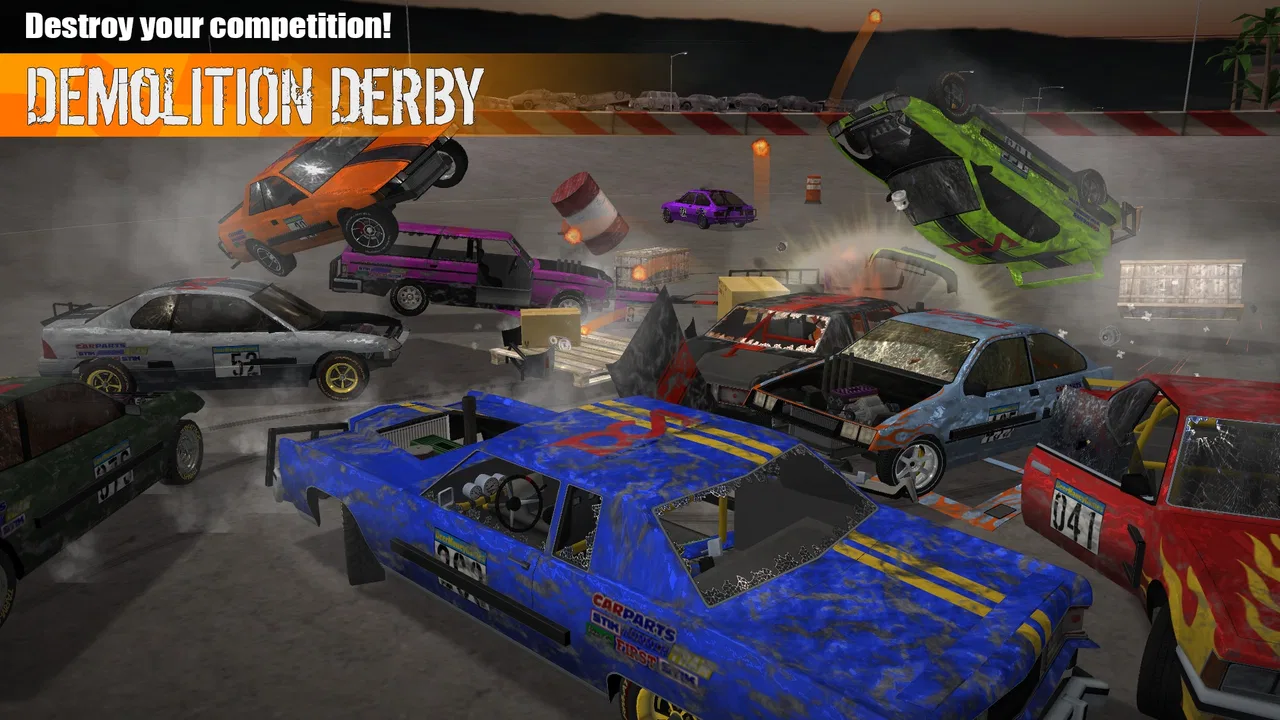
Demolition Derby 3
- 4.7
- Rating
- 10.00M
- Installs
- Free
- Price

 Analysis by App-foxy
Demolition Derby 3 is the kind of racing game I open when I want driving to feel messy, physical, and immediately entertaining rather than perfectly clean. Instead of treating every race as a test of smooth cornering, it makes contact part of the plan. Cars crash, routes open into broader driving spaces, and a good run often depends on choosing when to attack and when to stay out of trouble.
I found that mix more interesting than the usual mobile racer because it gives ordinary driving decisions a second layer. You are not only asking which line is fastest; you are also judging whether a shortcut is worth the collision, whether another car is setting up an easy target, and whether your vehicle can survive one more aggressive move. That makes each event feel less predictable than a standard lap-based race.
The game is free to download and comes from Beer Money Games!, a developer that has built its identity around this rougher style of racing. It is rated Teen, runs on Android starting with version 6.0, and the current version is 1.1.187. Its scale is easy to notice: it has passed 10 million installs and holds a 4.7 average from roughly 547 thousand ratings. Those figures do not replace personal experience, but they do suggest that the demolition-focused formula has found a sizeable audience.
You May Also Like

 Blood Strike: 2.5 Anniversary
Blood Strike’s Loadouts Turn Every Drop Into a Tactical Gamble
A close look at Blood Strike’s custom loadouts: how fast access to signature weapons reshapes its battle royale rhythm, rewards preparation, and narrows the gap between fights.

 Pandora - Music & Podcasts
Pandora’s Music Is Easy to Start, but Harder to Recover
Pandora’s strength is its low-effort path from a seed to a station. Its weak spot is how much confidence it asks you to place in connection, setup, and quiet recovery.

 8 Ball Pool
 Is Built on Rivalries, Rematches, and Routine
A close look at the rivalries, rematches, shared routines, and unanswered safety questions that turn a quick pool match into a persistent mobile community.

 Samsung Music
’s Quiet Strength Is Playing What You Already Own
Its reach comes less from spectacle than from dependable access to a personal library. That simplicity is both the app’s strongest retention engine and its ceiling.

 AccuWeather: Weather Radar
AccuWeather Review: A Quick, Clear Forecast for Everyday Decisions
For everyday plans, the best forecast is the one you can understand quickly. AccuWeather makes rain timing, radar, and local conditions easy to act on, with a few trade-offs.

 Hill Climb Racing
Why Hill Climb Racing Still Turns Crashes Into One More Run
A tiny car, a bumpy hill and one more upgrade: Hill Climb Racing keeps resurfacing because its simple chaos makes every near-miss feel personal.
More From Our News Desk



How I approach a normal session
My baseline workflow is simple. I begin with a few low-pressure races instead of immediately trying to dominate the most chaotic event available. That gives me time to feel out the steering, see how much space the arena offers, and notice which opponents are likely to create trouble. In a game built around impacts, learning the rhythm of the vehicle matters more than memorizing a perfect racing line.
Early in a session, I try to separate three situations that can look similar on screen. A direct hit can be useful if it turns an opponent away from the route, but a glancing collision may only slow both cars. Meanwhile, following too closely can leave me trapped when the vehicle ahead suddenly changes direction. I get better results by leaving enough room to react, then committing to contact when the angle is favorable.
That habit is especially useful in open driving areas. The wider environment makes the game feel less like a narrow circuit and more like a place where I can choose my own approach. I can test different routes, look for cleaner access to the next section, or use open space to avoid a cluster of cars. The trade-off is that freedom can also make a run less efficient if I drive around without a clear goal.
For a short everyday session, I would play one or two events while waiting for an appointment or taking a break. I would not expect every run to be a complete strategic exercise. Sometimes the appeal is simply lining up a satisfying crash. Other times, I use the session to practice staying mobile and avoiding unnecessary damage. The game supports both moods, although players seeking calm, exact racing may find the constant disorder tiring.
One useful routine is to treat the opening moments as reconnaissance. I watch how the pack spreads before forcing my way through it. If several cars are fighting in one area, the safest move is often to pass around the edge rather than join the first collision. This sounds cautious for a destruction game, but preserving control early gives me more options later.
Settings that deserve attention before serious racing
I recommend checking the control settings before deciding whether the game feels comfortable. Mobile racing can be enjoyable or frustrating depending on whether the steering method matches the way you hold the phone. I prefer to spend a few minutes testing the available control arrangement in a forgiving event rather than trying to adapt while surrounded by cars.
The important question is not which option looks most advanced. It is whether I can make small corrections without accidentally turning too far. Demolition Derby 3 rewards deliberate positioning, so a control setup that encourages constant overcorrection makes both racing and collisions harder to manage. I also like to confirm that the buttons I use most often are easy to reach without covering too much of the action.
Graphics settings are worth checking on older devices as well. The game supports Android 6.0 and later, but compatible does not mean every phone will deliver the same comfort during busy crashes. If the image becomes distracting or input feels delayed, I would reduce visual demands where the game allows it before blaming my driving. A stable response is more valuable here than squeezing out a prettier scene.
Sound is another practical choice. Loud crash effects help sell the impact, but they can become tiring during repeated attempts. I often lower the volume when playing in public and keep enough sound to recognize the flow of the event. If I am practicing a route or trying to improve consistency, a less aggressive audio mix helps me concentrate on steering rather than reacting to every explosion of noise.
The free-to-play structure also deserves a deliberate approach. Optional purchases range from $0.99 to $4.99 per item, so I would decide in advance whether I am comfortable spending anything. I prefer to play first without treating purchases as part of the basic control strategy. That keeps my early opinion focused on the driving itself and avoids turning every difficult event into a reason to buy something.
Teen content rating is another point parents should consider. The central appeal is vehicle destruction, not realistic driving instruction, so I would not present it to a child as a harmless substitute for a conventional cartoon racer. For older players who enjoy crashes and competitive contact, the rating feels consistent with the tone.
Repeatable patterns that make races cleaner
After spending time with the game, I found that experienced play is less about constant aggression and more about repeating a few reliable patterns. The first is to attack from an angle that keeps my own car moving. A head-on collision may look powerful, but it can leave both vehicles exposed. A side impact, followed by an immediate change of direction, usually gives me a better chance to continue the run.
The second pattern is to use open space as a resource. When the track or driving area widens, I avoid automatically taking the middle. The center may offer the shortest route, but it is also where traffic tends to collect. Moving toward a less crowded side can cost a little distance while saving enough control to make the next section easier.
I also try not to chase one opponent across the entire event. Focusing too narrowly makes me miss walls, oncoming vehicles, and better opportunities elsewhere. If a target escapes, I return to the route and look for the next useful position. This is one of the clearest differences from a conventional racer: the best decision is sometimes to abandon a personal grudge and protect the overall run.
When I want to improve, I repeat the same type of event with one specific goal. On one attempt, I may concentrate on clean turns. On another, I may practice surviving the opening traffic without taking a major hit. This is more productive than simply replaying until a lucky result appears, because it reveals whether a problem comes from steering, timing, or poor judgment about when to engage.
Another practical tip is to enter collisions with an exit already in mind. Before making contact, I ask where the car will point afterward. If the answer is toward a barrier or into a dense group, the impact may not be worth it. If the answer leaves a clear route, the same collision becomes a controlled shortcut through the chaos. That small pause separates deliberate destruction from random bumping.
For multiplayer sessions, I would apply the same principle but with less expectation that opponents will behave predictably. Human players can punish obvious attacks, so repeating one favorite move quickly becomes a weakness. I prefer mixing defensive positioning with occasional pressure, especially when several cars are competing for the same narrow approach.
Where the open-world idea helps, and where it does not
The open driving component gives the game a useful change of pace. I can explore, practice movement without the immediate pressure of a tightly packed race, and approach events with a better sense of how the environment connects. That makes it more flexible than a racer built only from short, isolated laps.
Still, open space is not automatically meaningful exploration. Players who want a large world filled with deep activities, detailed progression, or a story-driven structure should keep their expectations in check. Here, the freedom mainly supports driving, experimentation, and the possibility of finding a better approach. It is valuable because it changes how I move, not because it turns the game into a full open-world adventure.
This is also where the game differs from polished circuit racers. A conventional alternative is better when I want exact braking points, clean overtakes, and a strong sense of lap-to-lap improvement. Demolition Derby 3 is better when I want the route to remain flexible and the outcome to be shaped by contact. Neither style replaces the other; they satisfy different reasons for opening a racing game.
Compared with a pure demolition arena game, this title offers more variety in how I reach the action. I am not limited to waiting for opponents in one enclosed space. The racing, open driving, and multiplayer elements create more ways to spend a session, although the experience still revolves around vehicles colliding and surviving.
Advanced limits and the friction I noticed
The biggest limitation is that destruction can become repetitive if I need a long-term competitive challenge. The first crashes are exciting because they change the race instantly. After many sessions, I start wanting more precision in the way damage, positioning, and recovery affect the result. Players who enjoy mastering a fixed simulation may find the game too loose.
There is also a tension between spectacle and control. The most dramatic moment is not always the best strategic moment. A huge collision can send the car into a poor position, while a modest shove can quietly create a much better route. New players may naturally chase the largest impact and then wonder why their results remain inconsistent. I had to learn that visual intensity and useful progress are not the same thing.
Multiplayer adds excitement but also raises the cost of mistakes. In a single-player event, I can often recover from a poor decision and continue experimenting. Against other players, an early collision may remove the time needed to rebuild momentum. I would recommend learning the basic handling first rather than using multiplayer as the place to discover every control and route.
The in-app purchase range is modest in absolute terms, but the free structure can still influence how a player approaches progression. Anyone who dislikes optional spending should decide on a personal boundary before getting invested. I appreciate being able to start without paying, yet I also think the game is a poor match for someone who wants a completely purchase-free experience with no temptation at all.
Device age can affect comfort too. Since the minimum operating system is Android 6.0, the game is accessible to a broad range of phones, but older hardware may not feel as smooth during crowded, destructive scenes. I would test it on the device I actually plan to use, especially if responsive steering matters more to me than simply being able to launch the game.
Finally, the Teen rating and destructive theme make this a specific kind of family choice. I would recommend it to teenagers and adults who understand that the fun is built around crashing cars. I would skip it for younger children or for anyone looking for realistic road awareness, gentle competition, or a relaxing driving simulator.
Who will get the most from it
I think the strongest audience is the player who enjoys short bursts of disorder but still wants room for improvement. You can play casually, yet there are meaningful habits to develop: choosing safer approaches, reading traffic, managing momentum, and deciding when a collision is actually useful. That combination gives the game more staying power than a simple crash toy.
It also suits friends who want multiplayer races where perfection is not required. A mistake can become part of the entertainment, and a late recovery may feel more memorable than a flawless lap. The game is less suitable for someone who measures enjoyment by clean visuals, strict simulation, or completely predictable handling.
Because it is free, I would suggest treating the first sessions as a genuine trial rather than assuming the large audience guarantees a personal fit. Play long enough to test both the racing and the open driving. If you enjoy adjusting your approach after a bad crash, there is likely something here for you. If the collisions feel like interruptions to the racing you really want, a traditional circuit game will probably be the better choice.
My verdict after learning its rhythm
Demolition Derby 3 works best when I stop expecting it to behave like a polished track racer and accept its own priorities. It wants me to react, improvise, and sometimes choose survival over speed. The open driving areas and multiplayer options give the destruction a broader setting, while the free entry makes it easy to find out whether that style suits me.
My strongest recommendation is to play with a repeatable plan: check the controls, begin cautiously, use open space, enter impacts with an exit route, and review one mistake at a time. Those habits turn random-looking crashes into decisions I can improve. They also reveal the central trade-off clearly: the more freedom and chaos the game offers, the less it delivers the exact precision of a conventional racer.
With a 4.7 average and about 62 thousand written reviews, it has clearly connected with a substantial racing audience. I would recommend it to teenagers and adults who want destructive driving, flexible routes, and competitive sessions that can go wrong in entertaining ways. I would skip it if my priority were a quiet simulator, a deeply structured career, or perfectly controlled lap racing. For everyone else, it is a convincing free option with enough tactical detail to reward more than button-mashing.
FAQs for Demolition Derby 3
01What is Demolition Derby 3?
Demolition Derby 3 is a vehicle-combat racing game focused on crashing, surviving, and upgrading cars rather than completing traditional clean races. After trying it, the main appeal is the combination of demolition derbies, racing events, vehicle customization, and unlockable content. It is designed for players who enjoy aggressive driving, visible damage, and chaotic competition in short or longer sessions.
02Can Demolition Derby 3 be played offline?
Demolition Derby 3 offers gameplay that can generally be enjoyed without a constant internet connection, which is useful when traveling or playing in areas with limited service. However, some features may depend on connectivity, including advertisements, updates, online-related content, cloud functions, or other services. It is best to launch the game online occasionally so that progress and available content can update correctly.
03Is Demolition Derby 3 free to download and play?
The game is available as a free download, but players should expect optional in-app purchases and advertising. Progress can be made through regular gameplay, although purchases may provide extra currency, vehicles, upgrades, or convenience. Before downloading, check the store listing for the current pricing and payment details, particularly if children will be using the device.
04What gameplay modes and customization options does it include?
Demolition Derby 3 includes several types of driving challenges, with the central experience built around smashing opponents, surviving collisions, and earning rewards. Cars can be improved and customized through upgrades that affect performance and durability, while new vehicles and events provide longer-term goals. The exact selection can vary with updates, so available modes may differ between versions.
05Does Demolition Derby 3 require a powerful phone or tablet?
The game is built for mobile devices, but its 3D environments, vehicle physics, collisions, and damage effects can place a noticeable load on older hardware. A recent Android or iOS device with sufficient free storage should provide a smoother experience, while older phones may show reduced graphics quality, slower loading, or occasional frame-rate drops. Reviewing the official store requirements before installing is recommended.
Pros
- Large selection of cars with different handling characteristics.
- Destruction effects make collisions feel satisfying and impactful.
- Multiple camera angles improve control and driving visibility.
- Works well for quick races when you have limited free time.
- Frequent crashes create unpredictable and entertaining match outcomes.
Cons
- Some upgrades and vehicles require substantial in-game grinding.
- Aggressive AI can make races feel chaotic rather than skill-based.
- Menus and upgrade screens may feel dated on newer devices.
- Longer sessions can become repetitive once tracks are familiar.
- Touch controls may take time to master during crowded collisions.

Demolition Derby 3
Gallery